

- No products in the cart.
Search Results for: loaded
standard
standard
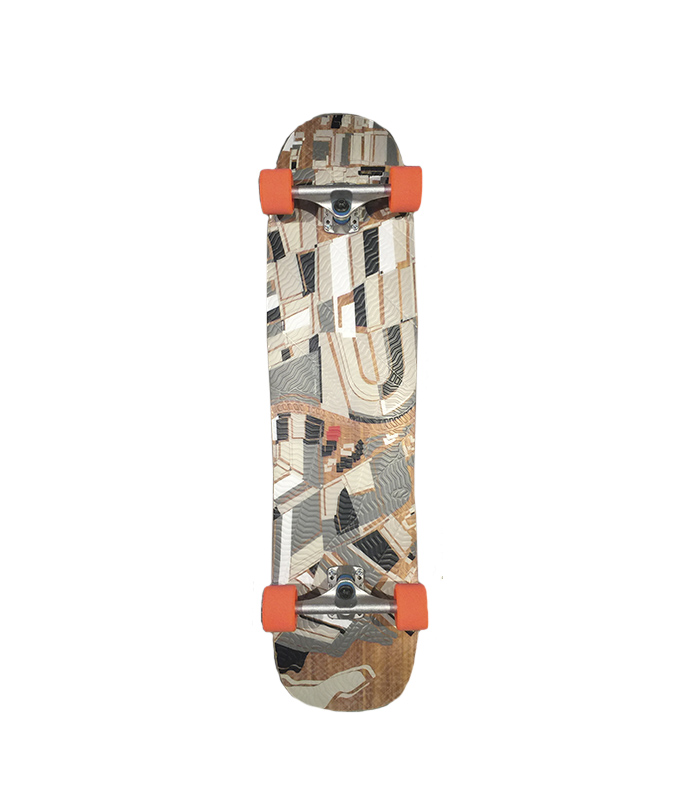
Loaded – Overland – Complete
Loaded – Overland complete with Polar Bear 155mm trucks, 80a Fat Frees and Zealous bearings.
Length: 37” (94cm)
Width: 9.5” (24cm)
Wheelbase: 20.75” and 22” (52.71 and 56 cm)
Rocker: 0.125″ / 0.318 cm
Concave: 0.50″ / 1.3 cm
Nose angle: 18°
Tail Angle: 13°
Nose: 4.9″ / 12 cm from outermost bolt
Tail: 5.9″ / 15 cm from outermost bolt
standard
Flatspot Weekly 17.04.16: Pantheon, Free Flatspot Swag, IDF Schedule and Loaded Longboards
Its been a long week! The newsletter/weekly wrap up is coming out on skater time. Whoopsies.

standard
standard
standard
standard
standard
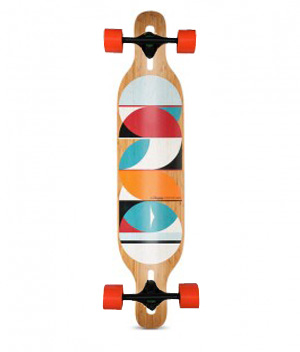
Loaded – Dervish – Deck
In 2007, the Dervish was our first venture into dropthrough construction and an opportunity to create a flexy, bamboo composite carver with the versatility to handle a variety of riding styles. Five years later, we’ve revisited this flagship board with new performance aspirations in mind.
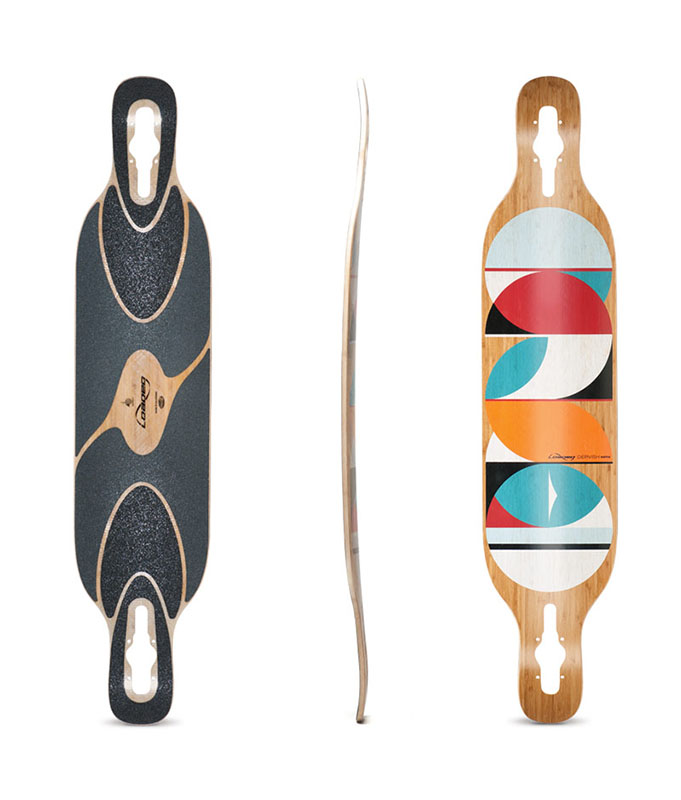
With a slightly wider platform than its predecessor, the Dervish Sama balances comfort, edge control, and responsiveness. Combined with a more pronounced concave profile, the extra width enhances turn initiation and slide control. We added subtle nose and tail kicks to increase pop and lock your feet in for freestyle tricks. The neck and dropthrough cutout were also updated for increased durability under hard riding. A six-piece griptape pattern provides enhanced control at the kicks and facilitates comfortable footwork maneuvers on the standing platform without interfering with the board’s flex pattern.
Length: 42.8″ / 109 cm
Width: 9″ / 22.9 cm
Wheelbase: 31.5″ / 80 cm
Weight:
Deck: 3.0 – 3.6 lbs / 1.4 – 1.6 kg
Complete: 7.0 – 7.6 lbs / 3.2 – 3.4 kg
FLEX
Flex 1: 170-270+ lbs / 75-122+ kg
Flex 2: 100-185+ lbs / 45-84+ kg
Flex 3: 75-150+ lbs / 35-68+ kg
SHAPE
Using sophisticated \(for us\) design software and curvature calculations, we extensively tested various different widths and subtle changes to the deck shape. We then collectively decided that this new 9\” wide shape \(the old Dervish was 8.5\” with a different neck curvature\) provided a satisfactory balance of comfort, edge control, and responsiveness.
CONCAVE
The Dervish Sama also received a more pronounced concave profile, which is further augmented by the increased deck width. The result is improved edge feel for turn initiation and extra control while sliding.
NOSE & TAIL KICKS
To keep up with the current caliber of freestyle riding, we gave the Dervish the most tasteful of nosejobs. After testing several new shapes and sizes, we lengthened the tips for additional leverage, widened the neck to increase durability and ensure a consistent flex pattern through the entire deck, and added subtle kicks to increase pop and to lock your feet in. The kicks are reinforced with an extra layer of fiberglass for added stiffness and durability.
GRIPTAPE
A six-piece symmetrical griptape pattern was designed with performance and elegance in mind. The two sections at the kicks use an aggressive, rougher-grit grip to provide enhanced control and security for manuals and freestyle tricks. The four middle sections use a milder, finer-grit grip \(comparable to street skate grip\) to facilitate dancing and footwork maneuvers. The segmented design yields functional coverage without interfering with the boards flex pattern.
CAMBER
The Dervish Sama’s versatility lends it to many disciplines, but at its heart lies a deeply rooted passion for carving. The cambered platform and weight-tailored flex pattern work together synergistically to provide a lively, flowing ride. Press your weight into a turn to preload the deck’s curvature; unweight as you finish the carve and feel the board snap back with positive energy return.
FLEX
Flex 1: 170-250+lbs / 75-114+kg
Flex 2: 100-185+lbs / 45-84+kg
Keep in mind that a softer flex pattern will give you more control and tighter turns at slower speeds and make it easier to slide, but tends to lose stability slightly at higher speeds. Stiffer flex means more energy potential, more stability at higher speeds, and makes air moves easier, but will not be as forgiving and lively when cruising.
NAME & GRAPHICS
Continuing our exploration in color theory and geometry, we looked deeper into Bauhaus principles to create this homage to the circle. By exposing multiple forms over one another, we were able to exemplify the arcing and flowing movements possible on this carving board and honor the whirling and spiritual experience debuted by its namesake. Lean this board against your Breuer chair or boardslide it into a custom work of art; either way, we think you will enjoy the new Dervish Sama.
CONSTRUCTION
Epoxy and triaxial fiberglass sandwich a vertically laminated bamboo core, pressed into concave and convex cambers for liveliness, responsiveness and high energy potential. Drop-through cutouts are CNC milled for precision.
HISTORY
In 2007, the Dervish was our first venture into dropthrough construction and an opportunity to create a flexy, bamboo composite carver with the versatility to handle a variety of riding styles. Five years later, we’ve revisited this flagship board with new performance aspirations in mind.
With a slightly wider platform than its predecessor, the Dervish Sama balances comfort, edge control, and responsiveness. Combined with a more pronounced concave profile, the extra width enhances turn initiation and slide control. We added subtle nose and tail kicks to increase pop and lock your feet in for freestyle tricks. The neck and dropthrough cutout were also updated for increased durability under hard riding. A six-piece griptape pattern provides enhanced control at the kicks and facilitates comfortable footwork maneuvers on the standing platform without interfering with the board’s flex pattern.
standard
Loaded Boards – Fattail – Deck
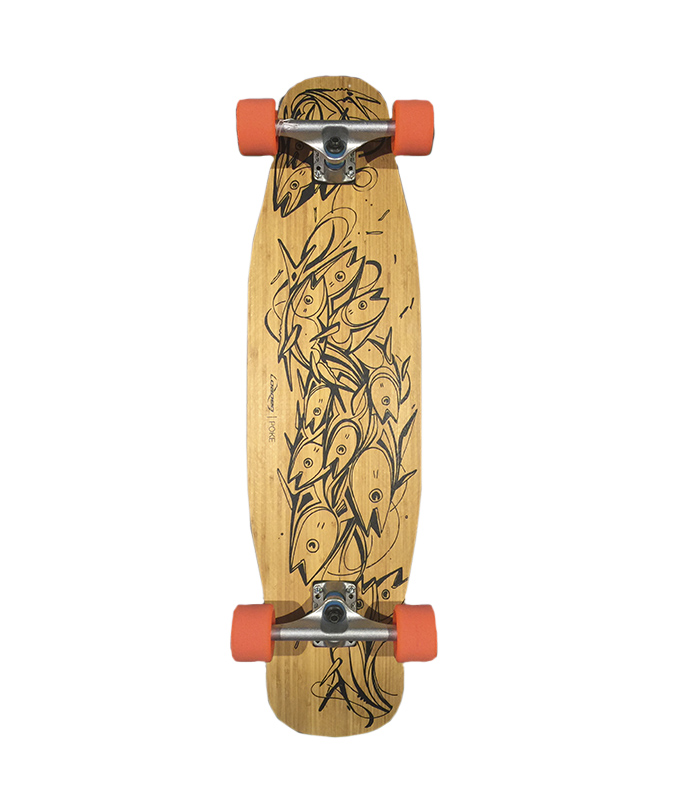
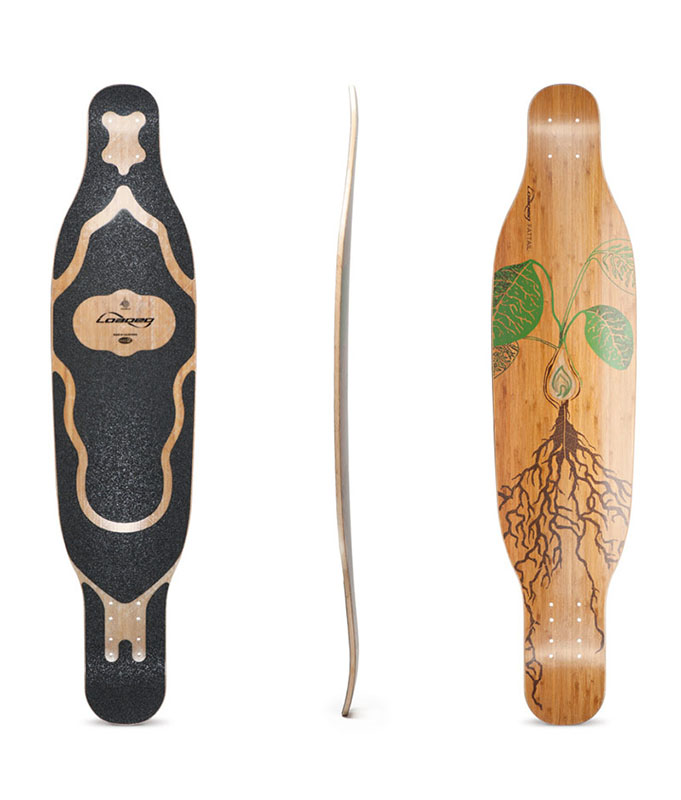
A little extra girth never hurt anyone. At least that was our approach when it came time to revamp the design of the Pintail. We wanted to modernize this classic concept so it could keep up with evolutions in riding and performance.
The Fattail was designed for pumping, carving, pedestrian slalom, freestyle and generally any situation where lively, energetic lines are on the menu. Increased concave locks your feet in against g-forces, while the topmounted and cambered platform provides energetic performance in and out of each carve. The width of the deck has been redistributed while maintaining subtle tapering near the trucks to provide both ample leverage and awareness of foot position while powering through turns. The formerly vestigial tail has received the silicone treatment for improved functionality in both freestyle tricks and surf-style shredding. The Fattail is also equipped with a slight nose kick for manuals and shuvits.
LONGBOARD SPECS
Length: 38″ / 96.5cm
Width: 8.63″ / 22cm
Wheelbase (Inner): 26.5″ / 67.3cm
Wheelbase (Outer): 27.4″ / 69.6cm
Weight:
Deck: 3.bs / 1.4kg
Flex
Flex 1: 170-270+ lbs / 75-122+ kg
Flex 2: 125-215+ lbs / 55kg-95kg
Flex 3: 75-175+ lbs / 35kg-80kg
CAMBER
Big and lively camber is the heart and soul of the Fattail. A carvy pumper at heart, the Fattail was designed with a healthy amount of camber to provide snowboard like responsiveness in a pocket sized package.
CONCAVE
A nominal concave provides a locked in feel and stiffens the deck without undermining the camber and flex characteristics of the board.
FLEX
We currently offer three flexes spread out over two lengths.
Flex 1: Up to 275 lbs/ <125kg
Flex 2: 125-215+ lbs/55kg – 95kg
Flex 3: 75-175+ lbs/35kg-80kg
A softer flex pattern will give you more control and tighter turns at slower speeds, however a softer board is more prone to lose stability at higher speeds.
If you plan on doing a lot of hard-pounding tricks like shovits and bonelesses, a stiff flex will hold up better. Note: It is natural for the boards to break in and become slightly flexier over time.
DIRECTIONAL SHAPE
An organic tapering shape preserves torsional stiffness and allows both heels and toes to maintain constant contact with the rails for optimal control in hard carving and pumping. Lots of clearance for big, fast, and grippy wheels.
NAME & GRAPHICS
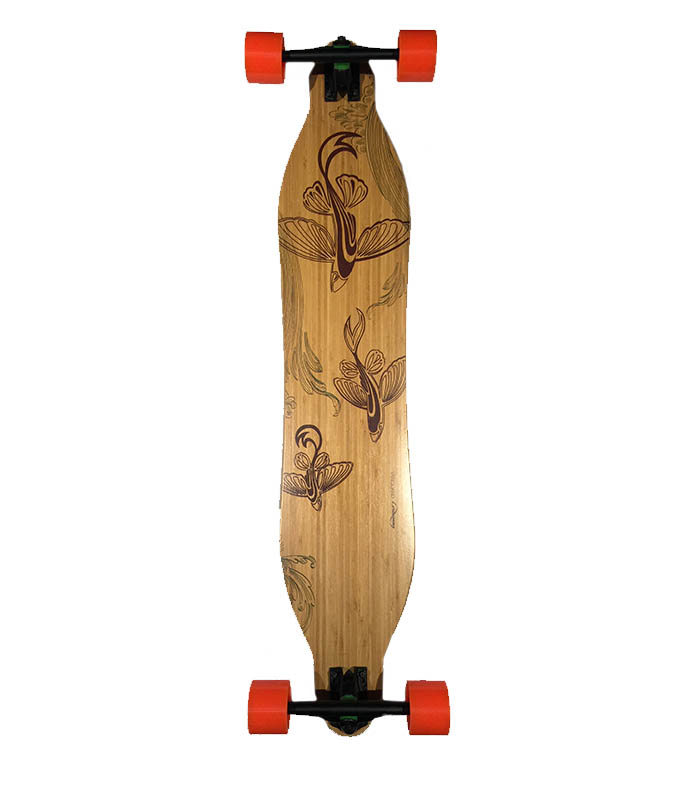
The Fattail graphic is an extension of the artistic concept explored in the two graphics used on the Pintail. The first graphic was designed by Jamie Engelman in 2004 as a meditation on change and growth. It was re-imagined more abstractly by Jan Michael Bennett in 2006 when we switched the Pintail from oak to bamboo. The current graphic was designed by Nana Studio (based on drawings by Daisuke Okamoto) and references the previous designs while expanding on the underlying concepts.
HISTORY
The Pintail was released in June of 2004 two years after the release of the Vanguard and a year after the release of the now defunct Fish and Hammerhead. At that point (and for a number of years following), Loaded was an uphill battle and the future was not looking too bright. Our boards were criticized for being too strange looking and quirky. We felt that form should follow function, but if we were to survive we needed to compromise aesthetically and create something more “traditional” looking. We therefore designed the standing platform of the Pintail with performance as the only design intent (at the time we had just started re-exploring tapered platforms) but let our love of surf and surf culture inspire the design for the nose, rear cutaway and tail. As of today, we’re stoked to be leaving this one foray into tradition-based aesthetics behind (and, in the process, creating a more functional and possibly more beautiful board in all regards). That said, one of the primary reasons we called this board the Fattail is as a reminder of what it has taken to get to where we are.
CONSTRUCTION
A vertically-laminated bamboo core is sandwiched between fiberglass skins. The tail is reinforced with an additional layer of fiberglass (top) and carbon fiber (bottom) for added stiffness and abrasion resistance. The bottom is finished with a bamboo veneer with a die cut water droplet pattern, which is filled with transparent urethane and a “floating” graphic to give a sense of dimensionality.